
F-Comfort and F-Pro manifolds - what are the differences and which one to choose
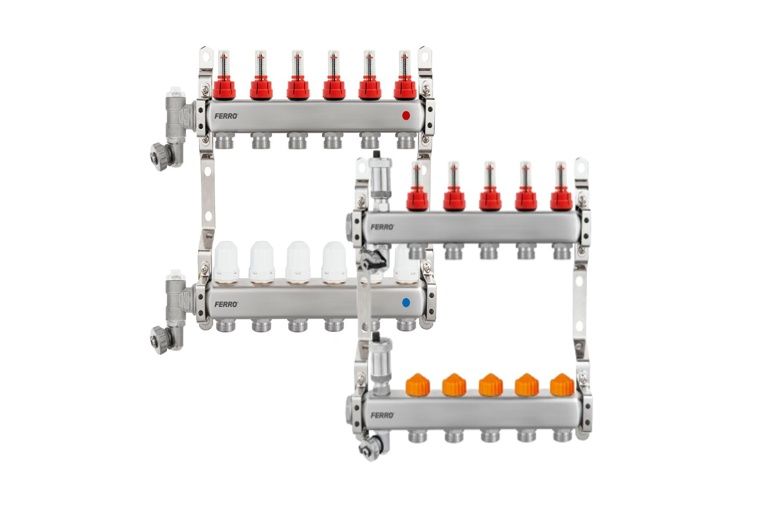
The FERRO F-Comfort (FC-RZPU••S) and FERRO F-Pro (FPR-RZPU••AB) manifolds are designed for underfloor heating, but differ in their construction, control method, and the role they play in stabilizing system operation. The first, part of the F-Comfort line—which includes standard solutions for typical systems—relies on classic flow control, while the second—from the F-Pro line, designed for the most demanding conditions—extends this function with automatic flow limitation in each loop. How do the two manifolds differ in practice, and which one should you choose for a specific system?
In this article, you will learn:
- how the F-Comfort and F-Pro lines differ,
- what design elements distinguish the two manifolds,
- how these design differences affect system regulation,
- what these solutions mean for the installer and the user
- which model to choose for a specific type of installation.
F-Comfort and F-Pro – understanding these categories
FERRO’s installation portfolio includes three product lines. F-Comfort covers solutions for standard applications where an attractive price-to-quality ratio is key. F-Power consists of products with higher performance parameters and a broader range of applications. F-Pro is a line designed for the most demanding applications, with an emphasis on advanced functionality and top-tier performance.
Consequently, the compared manifolds represent two different approaches to the same product group—underfloor heating manifolds. The FC-RZPU••S from the F-Comfort line was designed for standard underfloor heating installations that operate under stable, predictable conditions once commissioned. In contrast , the FPR-RZPU••AB manifold from the F-Pro line offers more advanced flow control and stabilization of individual loops.
FC-RZPU••S: classic flow control and automation-ready
The FERRO F-Comfort FC-RZPU••S manifold is equipped with a classic control system based on Taconova flow meters mounted on the supply pipe and thermostatic valves on the return pipe. The flow meters, calibrated in the range from 0 to 5 l/min, allow the installer to set and control the flow in each loop. The thermostatic valves, in turn, enable manual adjustment, and after installing M30x1.5 actuators, they also work with zone automation.
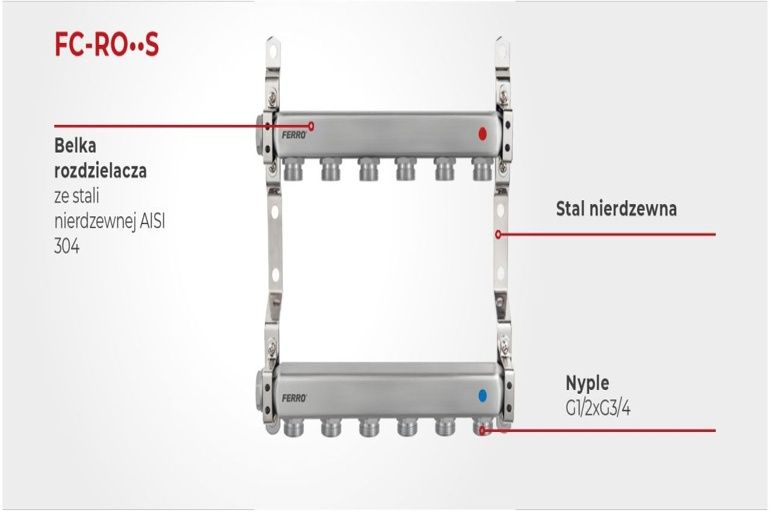
This solution gives the installer direct control over the manifold settings and allows them to adapt the system’s operation to the specific conditions of the installation. The FC-RZPU••S does not take over the hydraulic balancing process, but it provides clear and familiar tools for this purpose.
The functionality of this model is complemented by a manual air vent and steel brackets with rubber insulation that dampens vibrations and noise. The entire unit is a pre-assembled, ready-to-install manifold kit that simplifies installation and fits well into standard underfloor heating projects.
FPR-RZPU••AB: automatic flow limitation and system stabilization
The most important feature distinguishing the FERRO F-Pro FPR-RZPU••AB manifold from the F-Comfort model is the brass thermostatic inserts with an automatic flow limiting function. It is these inserts that change how the manifold operates. In this model, after setting the flow rate for a given loop, the installer can count on this value being automatically maintained regardless of pressure changes in the system.
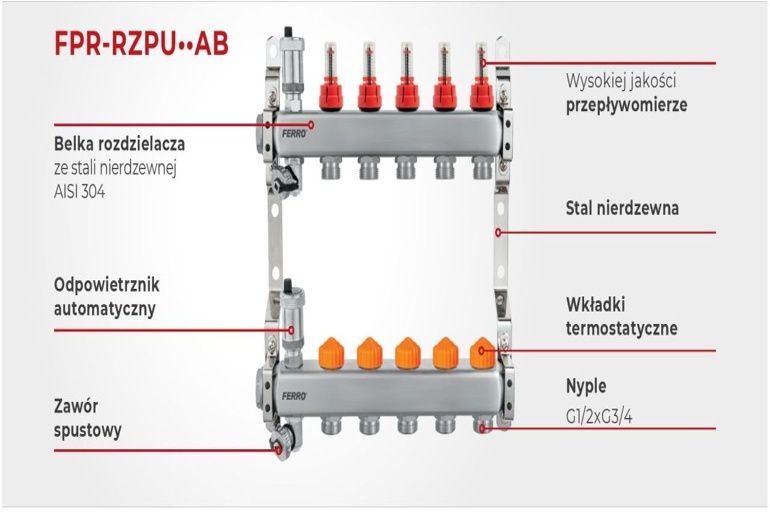
For each loop, the flow rate can be set within the range of 30–300 l/h. When one of the circuits is shut off, the manifold dynamically stabilizes the remaining loops and prevents them from overloading. This auto-balancing function is not present in the classic system used in the FC-RZPU••S.
The additional features also confirm that this model was designed with greater system autonomy in mind. Automatic air vents have been used instead of manual ones, and the flow meters serve only a monitoring function here, as flow regulation is handled by thermostatic cartridges with an automatic flow-limiting mechanism. The manifold retains the ability to mount M30x1.5 actuators, but its main advantage is reducing the need for manual adjustments and ensuring greater operational stability of the entire system.
F-Comfort and F-Pro Distributors - Comparison
F-Comfort FC-RZPU••S
- Control method - manual flow control by the installer
- Control element – Taconova flow meters 0–5 l/min and thermostatic valves
- Role of flow meters - regulation and ongoing monitoring
- Response to pressure changes in the system - requires manual adjustment and monitoring
- Ventilation - manual
- Operating characteristics - standard manifold for typical systems operating under stable conditions
F-Pro FPR-RZPU••AB
- Control method - automatic maintenance of the set flow rate
- Control element - thermostatic cartridges with automatic flow limiting function
- Role of flow meters - monitoring only
- Response to pressure changes in the system - dynamically stabilizes flow in loops
- Air venting - automatic
- Operating characteristics - a more advanced manifold for systems requiring flow stabilization
As you can see, the difference is not that one F-Pro manifold is simply a “more advanced” version of the F-Comfort manifold. These models represent different approaches to the same function: the FC-RZPU••S focuses on classic manual control, while the FPR-RZPU••AB focuses on automatically maintaining set operating parameters.
What these differences mean in practice
For the installer, the FC-RZPU••S will be a clear and predictable solution. It provides full control over flow settings, allows integration with zone automation, and works well where a standard, well-known method of system control is preferred.
The FPR-RZPU••AB is better suited for systems where hydraulic stability and minimizing manual adjustments are more important. Automatic flow maintenance can facilitate system commissioning and support more predictable loop operation.
From the end-user’s perspective, this primarily affects how the system maintains thermal comfort in the rooms. For the F-Comfort manifold, correct system setup during commissioning is critical. The F-Pro model, on the other hand, is designed to maintain the set flow rates in the loops even if the system’s operating conditions change. In practice, this promotes more stable operation of underfloor heating in systems with automatic control systems.
Which manifold should you choose?
If you need a manifold for a typical underfloor heating system that, once adjusted during commissioning, will operate under stable and predictable conditions, the optimal choice is the FERRO F-Comfort FC-RZPU••S model—a robust and fully functional unit.
If, on the other hand, dynamic flow stabilization is essential in the design because the system’s operating conditions will change—for example, by disconnecting individual loops—the FERRO F-Pro FPRRZPU••AB is the better choice.
Regardless of differences in design and control methods, both manifolds share FERRO’s high-quality craftsmanship. Both the F-Comfort and F-Pro models are complete, ready-to-install solutions backed by a 15-year warranty. This is an important consideration both for the installer, who is responsible for the efficient operation and durability of the system, and for the user, who expects reliable and stable system performance for years to come.
Read also:
F-Comfort, F-Power, F-Pro – how do the three FERRO product lines differ
How a hydraulic coupling works and the benefits of using it
Check valves in water and heating systems – function, application, installation
Want to buy FERRO products? Check out our store locations
Want to know more? Contact us